This article was originally published in The Sunday Guardian.
As consumers, we often forget that our individual modes of consumption end up changing the product itself. The fact that aspirin is now used to treat heartburn symptoms has transformed the pill. For all purposes, practical or otherwise, the aspirin is no longer what it used to be, even if the automated process used to stamp the brand name on it hasn’t shifted by a millimetre. Once this happens frequently enough, though, the product — if it is an industrial product, that is — embraces this change, puts it on like a new suit. As Kafka said in The Zürau Aphorisms, “Leopards break into the temple and drink the sacrificial chalices dry; this occurs repeatedly, again and again; finally it can be reckoned upon beforehand and becomes part of the ceremony.”

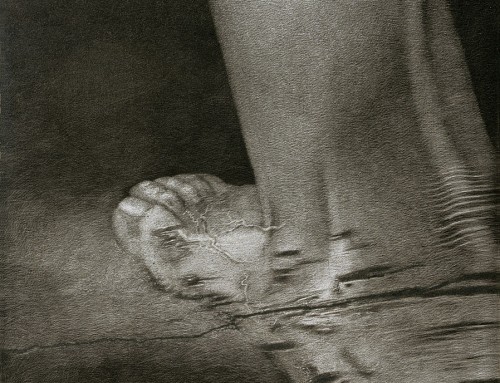
Instead, Broota took the infinitely braver path: to focus on the vulnerabilities of the male body. Earlier in his career, Broota made a series of ape paintings, placing them in contemporary social contexts. His “Man” paintings feature men only slightly more evolved than their earlier, simian counterparts. There are no discernible facial features anywhere to be seen. In Man 1, one of these blank slate Neanderthals appears with both of his hands hidden behind his back. Who’s holding him back? Are the shackles, perhaps, the same constraints that nudge him down a chauvinistic, patriarchal road? Or is the Neanderthal a more calculating, bloodless creature that stands by, hands folded in quiet complicity, as the evolving world passes him by?

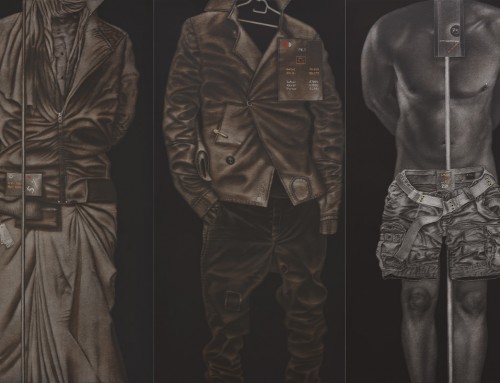
The first thing that you notice about Broota’s ape-to-Neanderthal progression is that while the apes were placed firmly in the middle of a vigorous, bustling satire (like 1976’s Sofa Set, where three apes are trying very hard to be well-behaved on a comically large sofa; beyond a point, both the enforced etiquette and the furniture appears to swallow them whole) the men have very few objects around them. The few things juxtaposed with them are very well chosen; that is, if the background isn’t all white, as is the case with some of his post-2000 works. It is this stark, unfussy style that Broota favours now: his 2014 triptych New Arrivals is perhaps the pick of the exhibition.

The message is you can get men to wear just about anything, if you know what appeals to the Neanderthal heart. In this conversation, “you” are an evil marketing genius (is there any other kind?), in which case, thanks for all the pseudo-intellectual brain-f***ing that you and your kind have unleashed so diligently upon our TV sets. (Next time, buy us dinner first.)
“Visions of Interiority” is by no means a one-dimensional exhibition, but its most memorable bits are the ones in which Broota lampoons society’s idea of how men are supposed to look and behave. At some level, we’re all still swinging at bears with clubs, hoping for the best.